Why Your Contracting Business Can Be Profitable and Still Run Out of Cash
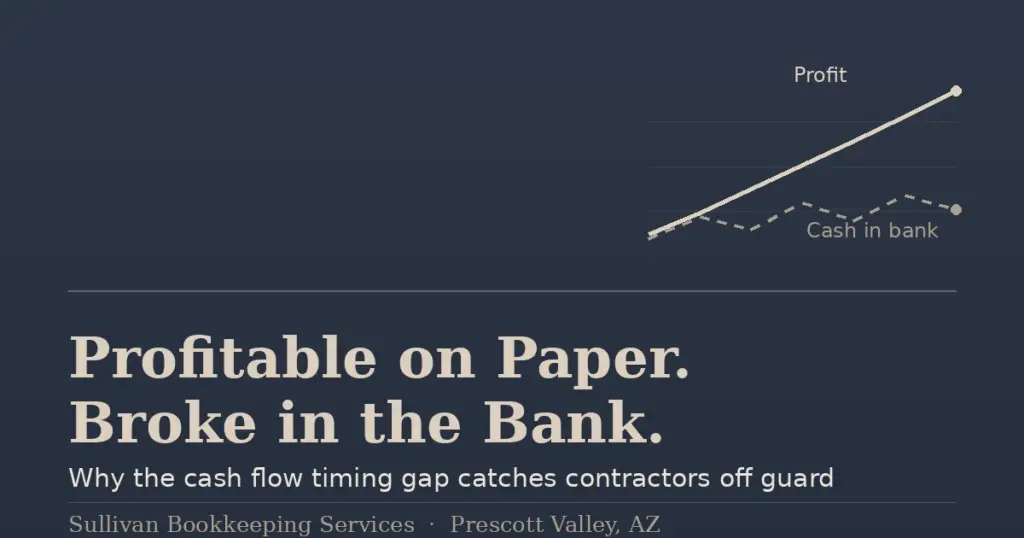
Your P&L says you made $50,000 last month. Your bank account says otherwise — barely enough to cover Friday’s payroll and this week’s supplier invoices. If you’ve been through this, you’re not imagining it, and you’re probably not doing anything wrong with your pricing or your margins. Most of the time, this isn’t a profitability problem at all. It’s a timing problem.
Profit Is an Opinion, Cash Is a Fact
Accrual accounting — the method most contractors’ books run on — counts revenue the moment you invoice a job, not the moment the money actually lands in your account. Your reports can show a healthy profit on a project you’re still owed for in full. That gap between “earned” and “collected” is where cash flow problems live, even in a business that’s doing everything else right.
Three Places the Gap Opens Up
Net-30 or net-60 payment terms mean the work — and the labor, fuel, and material costs to do it — happens weeks before you see a dime. Retainage often holds back 5–10% of a project’s value until final close-out, sometimes months later. Add in materials and deposits you have to fund out of pocket before a draw payment arrives, and even a well-margined job can leave you cash-poor for weeks at a stretch. And if you’re overbilling one job to plug a shortfall on another, you’re not fixing anything — you’re just borrowing from your own future self.
The Fix Isn’t (Just) Job Costing
If you’ve already tightened up your job costing and still feel the squeeze, the piece that’s usually missing is a cash flow forecast: a simple week-by-week or month-by-month view of what’s actually going to hit your account, so a shortfall shows up on a spreadsheet before it shows up on payday.
At Sullivan Bookkeeping Services, we help Prescott Valley contractors build that visibility — real-time books, accurate job tracking, and a clear read on your actual cash position, not just your paper profit.
Get your free 15-minute Bookkeeping Review or call (928) 308-6491 to see where your cash is actually going.